History of Gailor Hall, Memphis Boys Town and the Boys Who Lived There
History 1939-1949
The Reverend Vernon Webster Lane
And
Gailor Hall/Memphis Boys Town
Introduction: This writing is a biography of The Reverend Vernon Webster Lane combined with a history of Gailor Hall because the two are inextricably linked. Although Father Lane was connected with Gailor Hall for only ten years of a life that spanned seven decades, the founding of Gailor Hall must be considered the most significant accomplishment of his life. The information for this project was derived from various documents including, but not limited to, Federal Census Records, Episcopal Church Records, military records, obituaries, numerous articles from The Press Scimitar and The Commercial Appeal, (Memphis, Tennessee Newspapers), the daily diary of the Rev. Marshall Wingfield, my personal memories and memories of several former residents of Gailor Hall who have contacted me.
Paul Beck
Eagan, Minnesota
February 18, 2011
Vernon Webster Lane was born January 30, 1894 in Roe, Queen Anne’s County, Maryland, The son of Thomas C. and Florence (Willis) Lane. His father was a carpenter. Finding work to support his family may have caused the father, Thomas, to move around. By 1900 the family had resided in Maryland, Pennsylvania and Delaware. By 1910 the family had returned to permanently live in the Baltimore area. In 1910 when Vernon was 16 years of age he had finished school and was employed as a printer in a printing office.
During the First World War all men of a certain age were required to register for the Selective Service System better known as the Draft. Vernon registered on June 1, 1917 at age 23 in Baltimore. His occupation listed on the registration form was teacher. He served in the U.S. Navy from July 30, 1917 until April 12, 1918. His Navy service was state side.
In 1925 he entered the DuBose Memorial Church Training School at Monteagle, Tennessee, a theological seminary of the Episcopal Church. Upon completion of seminary training he was assigned to the diocese of Puerto Rico and the Virgin Islands. He was ordained a deacon in January, 1926 and ordained a priest in September, 1926 by the Bishop of Puerto Rico. He served as an assistant at St. Paul’s Church in the Virgin Islands until 1927. In 1927 he was assigned as Curate at St. Paul’s Cathedral in Fond du Lac, Wisconsin where he remained until 1931. From 1931 to 1933 he was the Rector at St. Stephen’s Church in Cecilton, Maryland and Good Shepherd Church in Chesapeake City, Maryland. On November 10, 1933 he was assigned as Rector of St. Martin’s of Tours in Omaha, Nebraska where he remained until February 1937 when he became the temporary Rector of the Church of the Good Shepherd located on the corner of Mill Avenue and Fourth Street in Memphis, Tennessee due to the illness of the permanent Rector. On December 16, 1937 he accepted the position on a permanent basis.
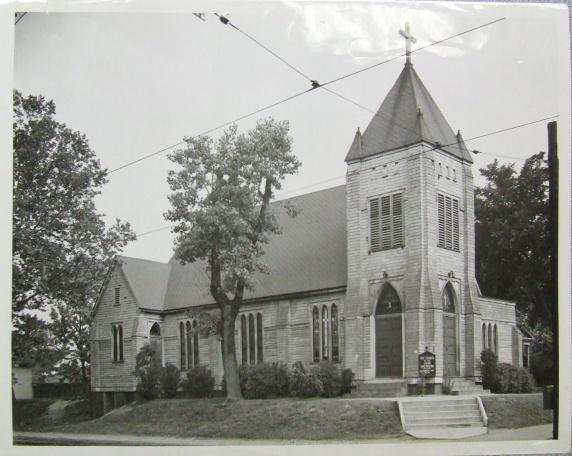
Church of the Good Shepherd
Upon his arrival at the Memphis Church he began to have an immediate impact in the neighborhood. He observed the neighborhood homes and buildings in run down conditions, including the Church Rectory, which was ready to be condemned. New sills were put under the house. It was repainted inside and out and redecorated. A new kitchen and bathroom were added, all at a total cost of about $2,000. He determined that the whole neighborhood around the Church could be rehabilitated into a cleaner, brighter part of North Memphis. He advocated simple things first. Vacant lots could be cleared, shrubbery planted, old fences mended and whitewashed. Later houses could be redecorated.
The Church and the rectory became a magnet for the children in the neighborhood. They began to see Father Lane as a contact to discuss family problems and a source for help and tutoring for their schoolwork as well as a safe place to play. A lady who knew Father Lane in Ashland, Nebraska as a child wrote about Father Lane in her memoirs: “Eventually he received a call from a church in Memphis, Tennessee and accepted that call. The summer that I was 11 years old he invited me to come to Memphis to visit him with the organist from his church in Omaha, Alice Oglebay. It was my first ride on a train and my first time away from my parents for several days. Father Lane, being the magnet for kids that he was, had lots of neighborhood kids for me to play with”. That summer was 1938. In retrospect, Father Lane seems to have had an interest in working with boys from an early age. In 1914 at age 20 he was an Assistant Scout Master in the Baltimore Council of the Boy Scouts of America.
On October 10, 1938 it was announced in The Commercial Appeal that Reverend Lane was engaged to be married to Miss Sara Marie Sanford with the wedding to take place later that year in Sewanee, Tennessee. The article reflected Father Lane’s background including his education. It stated part of his education was from Harvard University, which was a bit misleading. During the First World War the U.S. Navy had contracted with Harvard to establish a technical training school to train its members to be ship electricians. It was under those conditions that Father Lane attended Harvard while in the Navy. He received no undergraduate education at Harvard. It was said in the article that Miss Sanford was the daughter of Dr. and Mrs. Conley Hall Sanford, a prominent Memphis physician. She was not a biological child of the doctor and his wife. They had wed in December, 1929. Perhaps she was a foster child. She had recently graduated from Saint Mary’s School in Sewanee. That school was administered by the Episcopal Order of the Sisters of Saint Mary. Mrs. Sanford had been educated at Kemper Hall, another school administered by the Sisters of Saint Mary in Kenosha, Wisconsin. Perhaps that was the connection between the prospective bride and Mrs. Sanford. Sara was also an associate of the sisters of Saint Mary and a teacher at the school in Sewanee. There was a significant difference of the ages of the couple. The bride was in her early 20’s while Father Lane was nearly 45. The wedding took place on December 15, 1938. Immediately after the ceremony the couple left on a trip to the Gulf Coast. They returned to take up residence at the Church Rectory and upon their return they were feted with a reception given by the Woman’s Auxiliary of the Church. The reception was attended by several prominent Memphians. I will return to the fate of the marriage later.
THE EARLY DAYS OF GAILOR HALL
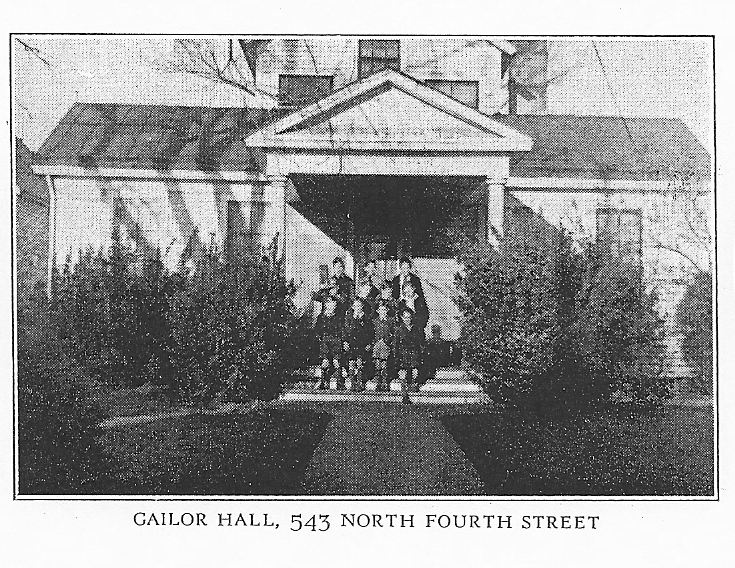
It seems Father Lane for several years had a desire to help needy and homeless boys, probably after having seen the fine work done by Boys Town founded by Father Flanagan in Omaha. Apparently Camille Kelley, the Judge of the Memphis Juvenile Court was aware of Father Lane’s desires and on March 15, 1939 made three boys from a broken home wards of Father Lane. Those three boys were the Brady brothers; Charles age 9, Jack age 11 and Robert age 12. Father Lane took the boys home with him to thbe Church Rectory. Judge Kelley placed additional boys with Father Lane and some came from the neighborhood placed by their parents. By September 23, 1939 there were seven boys there. The only financial aid in those early days was a $100 fund that Bishop of the Tennessee Diocese, Thomas F. Gailor, had accumulated before his death in 1935. That small fund was turned over to Father Lane and his endeavor came to be known as Gailor Hall in honor of the late Bishop.
The Rectory of the Church of the Good Shepherd
Subsequently, the attic of the Rectory was renovated and made into a bright and cheerful dormitory. Then several members of the church and others began to donate, time, money, food and hard goods to sustain the venture. By March, 1940 a workshop had been built in an old garage on the property where the boys’ hands and minds were kept busy. Some names of the earliest residents have been gleaned from newspaper articles and they were Robert Brady, Charles Brady, Jack Brady, James Spencer, Charles Sanders, Marion Winsett, Roy Perkins and Robert Rushing. One of those early residents has informed me that when he arrived, Father Lane’s wife was there. Shortly afterwards Father Lane told him and some of the other boys his wife had given him an ultimatum to choose her or the boys and Father Lane chose the boys so the wife left. I can find no record of a divorce in Memphis or Shelby County. Perhaps the bride moved away and filed for divorce in another County or State.
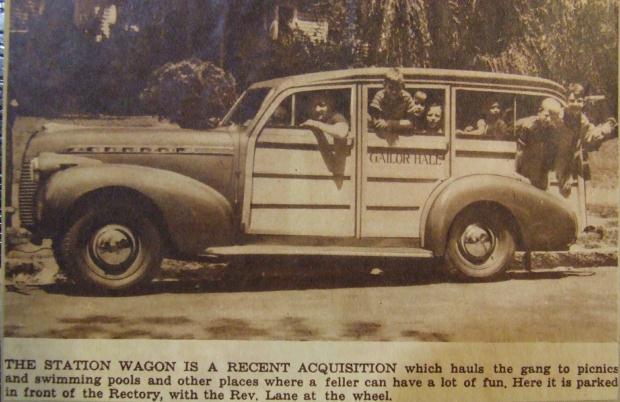
In July 1940 there were fifteen boys ranging in age from three to thirteen residing at Gailor Hall. Father Lane purchased a 1940 Chevrolet Station Wagon and painted a logo on the door which read “Gailor Hall Just A House Full Of Boys.” Soon after purchasing the Station Wagon he took all fifteen on a journey to the Cumberland Mountains and Washington, D.C.
With the increasing time it took for Father Lane to administer to the care of the boys he realized it was interfering with his duties as the Rector and on September 19, 1940 he submitted his resignation. In a letter sent to some Gailor Hall friends he stated “I have had to choose between the rectorship of the church and the direction of the boys at Gailor Hall. Some have resented the intrusion of the very-much-alive boys at the rectory and in the life and time of the rector. It would not be honest to continue as rector of the Church of the Good Shepherd just in order to continue a work that the parish is not interested in, no matter how worthwhile we may feel it to be. I am not sorry that I have presented my resignation to the vestry of the Church of the Good Shepherd. I think they will accept my resignation.” Father Lane suggested to the vestry that the church might flourish under another rector and asked that his resignation be accepted December 12 or earlier if the church secured a rector before then.
The resignation was accepted and on November 2, 1940 Father Lane accepted the post of associate rector of St. James parish, of which the rector was the Reverend Israel H. Noe, effective December 12, 1940. Along with the assignment, Gailor Hall became the obligation of the parishioners of St. James. The resignation from Good Shepherd required giving up the rectory that had housed Father Lane and the thirteen boys. A new board of directors was formed and a search for new quarters was initiated. The search was successful and on November 20, 1940 a 90 year old empty mansion located at 1055 Poplar was rented and soon became home to Father Lane and the boys. When the move was completed a house mother and cook, Mrs. Lillian Bell Raley was hired. Then the boys were transferred from LeRoy Pope elementary school to Maury elementary school.
At that time Father Lane reported that 28 boys had been under the jurisdiction of Gailor Hall with 12 of them readjusted and returned to their homes. On January 9, 1941two anonymous gifts totaling $600 were given and used as a down payment to secure a mortgage. By then nineteen boys were residents of Gailor Hall.
Shortly after the move to Poplar Avenue Gailor hall became a non-profit corporation. The Charter of Incorporation for Gailor Hall, Inc. was filed with the State of Tennessee on the 4th day of February 1941. The charter was registered and certified by the Tennessee Secretary of State on the 7th day of February 1941. The charter was filed by the Reverend Vernon W. Lane and a 12 member Council. The principal address for the corporation was 1055 Poplar Avenue, Memphis, Tennessee. The general purpose, or object, of the corporation was to support, maintain, manage, regulate, supervise, and provide a home and such other facilities as may be necessary, proper, or expedient for the rearing, educating, training, or otherwise caring for underprivileged, homeless, delinquent or semi-delinquent boys or boys of other classifications or descriptions as provided for by Sub-Section 2 of Section 4146 of the Michie’s code of 1932, which provides for charters to individual organizations for the general welfare of society, and not for individual profit. To operate said home under the auspices or sponsorship of the Protestant Episcopal Church but not subject to its direction.
When Father Lane incorporated Gailor Hall, Inc. he surrounded himself with a Council consisting of prominent Memphians. One of them was Bishop James M. Maxon, who was the current Bishop of the West Tennessee Diocese and who had succeeded Bishop Gailor upon his death in 1935. Another was Walter Chandler, lawyer, politician and state legislator. He also served in the U.S. House of Representatives and was the mayor of Memphis when Gailor Hall, Inc. was formed. Another was Marshall Wingfield, author, historian and minister. He was the pastor of the First Congregational Church and President of the West Tennessee Historical Society. Still another was Frank Hoyt Gailor. He was the son of Bishop Gailor. He graduated from the University of the South in 1912 and was named a Rhodes Scholar. He went on to become a lawyer and served as the Shelby County Attorney, a Circuit Judge and a Tennessee State Supreme Court Justice.
Toward the end of March, 1941 serious disagreements between Father Lane and Reverend Noe over the control and administration of Gailor Hall had evolved. Following a meeting on March 28, 1941 attended by Bishop Maxon, Father Lane, Reverend Noe and some of St. James vestrymen Father Lane resigned his post at St. James. The disagreements between the two ministers were revealed very publicly in several articles in the Press Scimitar and the Commercial Appeal. The disagreements involved, among other things, expenses and budgeting for Gailor Hall. It seems the real “sticking point” might have been religion. Father Lane stated “Rev. Noe held that all the boys in the House should be made to attend the Episcopal Church, while I did not feel that a boys’ importunity should be made an occasion for proselytizing. All but two of the boys do go to the Episcopal Church, but one boy has very definite ideas about his religion and belongs to the Baptist Church, and another boy is a very faithful member of Sacred Heart Church”. Of course, Rev. Noe disagreed with Father Lane, stating “It was at Bishop Maxon’s request that Father Lane was called to be associate rector of St. James Parish in charge of boys work, and that St. James Parish undertook to sponsor Gailor Hall for Boys. It is inconceivable to me that a priest of the church called to be associate rector in charge of boys work could feel that he had a right to go off and organize that work as a free lance, individualistic institution, responsible to no one but himself, receiving help but welcoming no advice.” Bishop Maxon cited canon law to inform Father Lane that his resignation disqualified him to perform any priestly functions such as weddings, baptisms and burials. Nevertheless he did resign and Gailor Hall became independent from any parish.
Then came a “big break”. The Memphis Co-operative Club (now Sertoma Club) had long searched for a worthwhile project. Dr. Wingfield suggested Gailor Hall -and it was done. A regular monthly allotment, plus $25 a month for groceries, gave the home its first dependable financial assistance. The ladies club, the “co-operettes”, meanwhile worked for the boys as their own.
Some more of the boys who became residents were Freddie Montgomery, James “Chubby” Thayer, Billy Thayer, Charles Sanders and Donald Marcum. Mrs. G.C. Atwell – “Aunt Pat”-joined the staff to plan menus and supervise the kitchen.
On the grounds at 1055 Poplar was an old two room servant’s house. With help and donations of money, goods and labor from many individuals, including Father Lane and the boys of Gailor Hall the old building was renovated and converted to a chapel seating 40 people christened Saint Andrew’s dedicated on December 28, 1941. Apparently, Father Lane had returned to the “good graces” of Bishop Maxon as he dedicated the new chapel. And Father Lane was again permitted to perform ministerial rites. By this date Gailor Hall had 32 residents.
The Boys Painting The Old Servants Quarters
On April 3, 1942 Mrs. J.C. Brooks, a widow lady, donated $3300 to pay off the mortgage at 1055 Poplar and Gailor Hall was debt free. By then the total number of residents had grown to forty five boys.
In September 1942 my brother and I arrived at Gailor Hall. We had previously lived in Oxford, Mississippi. When my parents separated my mother moved us to Memphis so she could secure more lucrative employment. She placed us at Gailor Hall until she could acquire sufficient funds to purchase a home for her family. At that time the house mother was Grandma Brown. Father Lane’s mother also resided there and was known as Grandma Lane. His father, Thomas, had passed away on March 10, 1942 in Memphis. The death certificate indicated he was a “non-resident” and his home was Baltimore, so it can be assumed the mother and father were visitors to Memphis at time of his death.
Although Father Lane insisted the residents could worship in any religion they chose, he encouraged all the boys to embrace some religion. Many of the residents came from homes where there were no religious teachings and many of us embraced the Episcopal Church. Father Lane provided religious instructions. On April 25, 1943 a group of fourteen boys was confirmed by Bishop Maxon at St. Mary’s Cathedral. I can’t be sure that all fourteen were residents of Gailor Hall but I recognize some of the names. The fourteen were Walter Louis Barnes, Robert Sheafe Gooch, William Gene Harper, John Clifton Parker, Donald Brown Gatewood, Sidney Paul Beck (me), James Franklin Delaney, Richard Lee Rutherford, Eugene Rutherford, Robert Ernest Weakley, Walter Edward Thorpe, Gerald Jackson Beck (my brother), Richard Wilhite and Dallas Robinson. After my confirmation Father Lane trained me to be an altar server and I assisted him at Mass on many occasions.
THE BIG MOVE
By the summer of 1943 the house at 1055 Poplar was so crowded that new quarters were needed. The former home of the Poor Sisters of Saint Francis on Summer Avenue consisting of 43.5 acres with a large home, a chapel and several farm buildings became available. $72,500 was needed to purchase and recondition the property.
Father Lane and his Council developed a plan to raise the money to purchase the property. At a dinner on the evening of May 13, 1943 at the Gayoso Hotel more than 600 Memphis business and civic leaders met to hear Mary Pickford, “America’s Sweetheart” and others explain Father Lane’s plan to move his charges from their crowded city quarters to a farm home. Miss Pickford came at the urging of Judge Camille Kelley and “kicked-off” the fund drive with a $1,000 contribution.
By the next Month (June) $27,650 had been collected, with the expectation the goal would be achieved and the Gailor Hall boys moved into their new farm home outside the city limits on Summer Avenue. The early move prompted the Rev. Wingfield to place the following entry in his diary on June 17, 1943; “Out to the new home of Gailor Hall where the boys are now quite at home. Vernon Lane moved in before the financial reached the half-way stage. By doing so, he hampered the campaign, causing people to say they need not contribute since the place had been bought and occupied. Suppose the campaign had failed! He is indeed a difficult CoWorker and in many things exhibits the mentality of a 12-year-old boy”. The contributions eventually exceeded the goal by $15,000. As late as January 1947 Gailor Hall still owned the property at 1055 Poplar.
After the move the boys attended White Station School which consisted of grades one through eight.
Class of 1943-1944 at White Station School
Father Lane always encouraged the residents do well in school. To that end he established a connection with Phillips Academy, an exclusive private preparatory school in Andover, Massachusetts to provide scholarships for boys at Gailor Hall who could pass the entrance exams. There are many distinguished citizens who are graduates of Phillips Academy including Presidents George H.W. Bush and George W. Bush. In 1944 two boys from Gailor Hall, James Thayer and Billy Seffens successfully passed the entrance exam and were awarded $1000 scholarships. In September 1944 Father Lane accompanied the boys to Phillips Academy with sight seeing stopovers in Washington and New York. After one year at the Academy both boys were awarded a second year scholarship. Thayer declined the second year preferring to attend a local high school. Seffens returned to the Academy for a second year, but it is not believed he graduated as his name does not appear on the alumni listing which can be found on the Academy web site.
In July 1944 my mother purchased a house at 702 Woodlawn and my brother and I left Gailor Hall.
On September 9, 1945 a swimming pool had been constructed and was opened for the residents to enjoy.
A new Saint Andrew’s Chapel was constructed on the grounds of Gailor Hall at 4093 Summer Avenue and was dedicated on November 28, 1946 (Thanksgiving Day). On Christmas day in 1941 Mrs. J.C. Brooks had given $1100.00 to Father Lane to assist with his work at Gailor Hall. The original intent was to use the money to construct a gymnasium on the grounds at the old location at 1055 Poplar. But Gailor Hall was relocated to the Summer Avenue location before that came to fruition so the money was used to start a fund for the chapel construction.
WAS HE FALSELY ACCUSED OR WAS THERE A COVER UP
On January 22, 1947 Father Lane appeared before the Standing Committee of the Episcopal Diocese in Nashville regarding charges in his operation of Gailor Hall. The charges as publicly announced were vague stating only “conduct unbecoming a clergyman”. The committee recommended to Bishop Dandridge (who had succeeded Bishop Maxon) that Father Lane stand trial. The same day the executive council of Gailor Hall temporarily removed Father Lane pending the outcome of the trial. Mrs. Roberta Bell, executive secretary of the Gailor Hall executive committee was named to take his place. Judge Camille Kelley agreed to serve in an advisory capacity. In a letter to friends Father Lane stated: “I know that I am not guilty and trust that I will be able to establish my innocence in the ecclesiastical proceeding, and thus clear my name”. He added: “I will be represented by Episcopal lawyers without any charge to me. I have no money to speak of. All of the money that came to me went to the boys, even my wedding and baptismal perquisites.”
Bishop Dandridge appointed a five member panel to hear the charges and a trial was held at St. Mary’s Cathedral beginning June 10, 1947 and ending June 13, 1947. A spokesman for the panel announced: “After a full and complete four day hearing according to the canon law of the Episcopal Diocese of Tennessee on charges of conduct unbecoming a minister, the Rev. Vernon W. Lane was unanimously acquitted.” Following that announcement, father lane was immediately re-instated to head Gailor Hall. The executive committee issued the following statement: “The Executive Committee of Gailor Hall has always believed in Father Lane’s innocence and rejoice that this belief has been confirmed by the unanimous decision of the five trial judges of the Episcopal Church. We feel the matter was thoroughly investigated during the hearing which consumed four days and three nights. It was thought best to suspend Father Lane from management of Gailor Hall until the matter was finally decided, and we are now happy to announce that his suspension has been terminated and he has been restored to management of the affairs of Gailor Hall with our warm esteem and whole-hearted support.”
I was still residing in Memphis at that time and although only fifteen years old I have distinct memories of the rumors “floating around” about what the accusations against Father Lane were. They were ugly. It would not be fair to his legacy to repeat those rumors without some verification. It would help to clear the air if the records of the Standing Committee in Nashville and the ecclesiastical trial court in Memphis could be found. To that end I have made numerous inquiries to some officials of the West Tennessee Diocese to no avail. As a result of my inquiries I did learn the Diocese Archives were at one time housed at St. Mary’s Cathedral and then transferred to the library at the University of the South in Sewanee, Tennessee. I traveled to that institution in June, 2010 and was permitted to pore through all the records on hand. I located a diary maintained by Bishop Dandridge in which he recorded his daily duties and events. I found a mention of his presiding at the wedding of Father Lane and Miss Sanford in 1938. Also a mention that he had met with the five man trial panel the day before the trial started, but no details as to the charges. It seems the records regarding the charges have been either sealed from public view or destroyed.
REV. MARSHALL WINGFIELD’S DIARY
I have also located the daily diary maintained by the Rev. Marshall Wingfield who was the Chairman of the Gailor Hall Executive Committee. Beginning on Sunday, January 19, 1947 there were several entries regarding the charges against Father Lane. The entry on that date reads: “From 12 to 2 A. G. Riley, Bob Marks and I were closeted with the Fr. Lane matter – the charges against him that have destroyed our peace for a week. In the afternoon there were 3 conferences with Judge Kelley, one with Mrs. Roberta Bell, executive secretary of Gailor Hall, and one with Kenneth (“Buddy”) Guess, a 14-year boy of Gailor Hall who made such a damaging statement to the Bishop’s Committee against Fr. Lane and now denies it, and in the evening (till 10) another conference with Bob Marks who believes Fr. Lane guilty. Rained all day but the physical world not half so dreary and desolate as my heart.” Entry from Tuesday, January 21, 1947: “Had many telephone calls about the Gailor Hall calamity.”
The entry on Wednesday, January 22, 1947: “So long as this day is remembered by me, it will be remembered for its pain. After conferences with Ed Pike, Julian Lohmeyer, H. L. Kingery, I. P. Wortham, Talbot S. Mathes, and Co-Operative Club luncheon, I went to U.P. Bank where Judge Sam Bates, Julian Lohmeyer, Dave Jolly, Albert Riley and self were in conference about Gailor Hall for 3 hours. In the evening the Gailor Hall Board, or Executive committee, met at my house and relieved Fr. Lane of all connection with Gailor Hall pending investigation of the charges which have been laid against him. After the meeting at the Manse, which adjourned at midnight, H. W. Buck, Julian Lohmeyer, Nick Hanson, Harry Freeburg, Albert G. Riley and I went out to Gailor Hall and sat till 2 A.M. with Fr. Lane. I hope never again to witness such distress. If he is innocent then I can’t think of a hell deep enough for those who have caused him to suffer so!”
The entry on Thursday, January 23, 1947: “Carl Marsh called for story on the Fr. Lane scandal before I had breakfast. I turned the matter over to our public relations counsel, Shirley Smith who came out to the Manse a little later that he might sit in on my conference with Bob Marks of THE COMMERCIAL APPEAL. Fr. Lane called early to ask address of Bishop Maxon . I gave it to him and he left early for Fort Walton, Fla.”
The entry on Saturday, January 25, 1947: “Early in the morning Vernon Lane telephoned from Jackson, Miss., to tell me that if his automobile continued to run as well as it was running, he would be at my house at 1 P.M. or a little earlier. Knowing his intention to return to Gailor Hall and to conduct services there tomorrow, and knowing such a return would precipitate criminal charges against him and cause the COMMERCIAL APPEAL to carry the full story of the charges against him, I was greatly disturbed and called the Gailor Hall Executive Committee of 16 men to meet at my house at 1:30 P.M. Had many calls and callers regarding Gailor Hall and failed to find any time to make preparation for tomorrow’s services. Fr. Lane arrived at 12:30. Judge Kelley called soon after his arrival to say that if he set foot on Gailor Hall premises criminal charges would be placed against him. I asked her to urge Fr. Lane personally and directly to stayaway and help us save the situation and she did so. Before she finished talking to Fr. Lane the members of the board had arrived and we had a long, harrowing, heart-breaking session, which continued even after I had gone to give my every-Saturday broadcast over WHBQ. Today I named investigating committee from the Gailor Hall board to look into the charges against Fr. Lane. The men constituting the committee are Albert G. Riley, Rudolph Johnson and Charles Glascock, all lawyers.”
The entry on Sunday, January 26, 1947: “Mrs. Bell telephoned to me quite early to say there is no more doubt in her mind as to Fr. Lane’s guilt of the charges which have been lodged against him, and that she has quit fighting. Judge Kelley phoned to tell me that she is going out of the city for a few days and that I must sit tight until her return. I replied that at 10 this morning I ended my efforts in Fr. Lane’s behalf.”
The entry on Monday, January 27, 1947: “Mrs. Roberta Bell called to say that she visited Father Lane last evening and gave him the latest development in the charges against him, and that he decided to offer his resignation and leave Gailor Hall. He did leave Memphis at midnight of last night. Later in the morning Mrs. Bell sent the resignation which Father Lane asked her to deliver to me. He based his resignation not on the real reason, which Mrs. Bell gave him but on the suggestion which I gave that the Community Chest might not continue to support Gailor Hall with Father Lane at the head of the home. Later in the day I had a conference with the officers of the Community Chest to determine positively in the matter and learned that the reason he gave for resigning is as real as the real reason he did not give. The Community Chest would withdraw its support of Gailor Hall if he returned as its head. Wrote letters to Bishop J. M. Maxon, St. Simon’s-on-the-Sound, Fort Walton, Fla., and Bishop E. P. Dandridge, Nashville.”
The entry on Wednesday, January 29, 1947: “Had conference with Bishop Edmund P. Dandridge. All conferences and letters for the day pleasant except those related to the dreadful charges against Vernon W. Lane, executive director of Gailor Hall. Oh why did I permit myself to be persuaded to continue as Chairman of Gailor Hall’s board. Nat Summerfield phoned to say Vernon Lane spent last night in the Summerfield home.”
There were no more entries in the Marshall Wingfield diary regarding Gailor Hall or Father Lane until Saturday, July 5, 1947 when he noted that he “presided over special meeting of Gailor Hall board in evening.” That would have been the meeting where Vernon W. Lane was returned to head Gailor Hall after he was exonerated by the Episcopal Church tribunal. Then on July 10, 1947 Rev. Wingfield resigned from the Chairmanship of the Gailor Hall Executive Committee.
FATHER LANE ENDS HIS LEADERSHIP OF GAILOR HALL
An article in the Press Scimitar February 4, 1949 contained Father Lane’s report to the executive committee for 1948. Among other things he reported that 27 boys had been received and 28 had been readjusted with parents or relatives or had gone away to school leaving 48 boys at Gailor Hall ranging in age from four to sixteen. The majority of the boys attended White Station School.
Articles in both Memphis newspapers on August 17, 1949 revealed Father Lane had resigned as managing director of Gailor Hall effective immediately and would be succeeded by the Rev. David E. Watts. Explaining his resignation, Father Lane said: “I have been on the job 24 hours a day, 10 years and five months to the day. I’m getting old and crochety (sic) and worn out, and I think Gailor Hall will flourish and go forward under the leadership of a young man. I want to remain long enough to give Father Watts the benefit of my experience and help him in any way I can.” The chairman of the board of directors said Father Lane had twice previously expressed a desire to retire. When he repeated his desires again the executive board told him to take a month’s vacation and think it over. When he returned from vacation with his position unchanged his resignation was reluctantly accepted.
Father Watts and Father Lane
Father Watts’ tenure at Gailor Hall was short lived and he was succeeded by Mr. Harlan M. Jeffery, Jr. on July 31, 1950. The article in the Commercial Appeal described Mr. Jeffery as a recent graduate of Purdue University and also a graduate of Central High School where he was a member of the football squad and track team. While at Purdue he was on the college football varsity squad and was heavyweight boxing champion for three years.
On April 10, 1952 the Board of Directors filed a charter amendment to change the name from Gailor Hall, Inc. to Memphis Boys’ Town, Inc. The charter amendment was certified by the Tennessee Secretary of State on June 6, 1952.
Subsequently the institution went through several name changes and relocations and then on February 1, 1987 Memphis Boys Town, Inc. ceased to exist. Memphis Boys Town, Inc. and Dogwood Village of Memphis-Shelby County, Inc merged into a single entity known as Youth Villages, Inc.
Several months after resigning from Gailor Hall Father Lane returned to his native state of Maryland in 1950 where he served as Rector of Christ Church in Stevensville, Maryland until 1952 when he left the active Ministry. When he left the Ministry in 1952 he was employed as a manager of a TourInns Motel in Kent Island, Maryland. In 1958 he was hired as the crafts and wood shop teacher at an exclusive co-educational boarding school known as Cherry Lawn School in Darien, Connecticut. Cherry Lawn School no longer exists but there is a web site giving the history of Cherry Lawn School. The web site contains voluminous information about the school including copies of several yearbooks for the years Father Lane was employed there. I have found his photo in some of the yearbooks. The names and email address of many of the graduates are listed on the website. I contacted every graduate who attended during the years Father Lane was employed there and asked if they had any recollections of “Mr. Lane” as he was known there. Many did not, but several did. All who knew him or attended his classes spoke highly of him. Only one was aware of his past as a clergyman.
FATHER LANE AFTER GAILOR HALL
Mr. Lane at Cherry Lawn School – 1964
That one is a son of the man who hired Father Lane at both the motel and the school. The man knew Father Lane when he was the Rector at Christ Church. That man became the head master at Cherry Lawn School in 1958 and hired Father Lane to be the Crafts and Wood Shop teacher there. When I asked the son if he knew why Father Lane left the Ministry he was reluctant to reveal the reasons but after several exchanges between us he told me Father Lane was using alcohol excessively and that led to some embarrassing incidents. His father thought Father Lane deserved a chance at employment.
It seems Father Lane left the active ministry of his own choosing. On January 30, 1962, his sixty eighth birthday, Father Lane began receiving a pension from the Episcopal Church Pension Fund. Sixty eight is the age of eligibility to receive a pension from the fund. The Diocese was shown to be “Secretary of the House of Bishops” and he was designated as a “Non-parochial Priest” on the report of those beginning to draw their pensions in 1962. After his death, his funeral services were conducted at St. Luke’s Episcopal Church.
Vernon Webster Lane died in Stamford, Connecticut on January 17, 1966 of a Myocardial Infarction (Heart Attack). Although he had no family members in the area where he died he apparently had shared details of his past with someone because the information on his death certificate and contained in his obituary was accurate with two exceptions. On the death certificate is an entry for “If married, widowed or divorced give maiden name of wife.” That was left blank. On both the death certificate and the obituary it was stated he had served in the Navy in WWI and in the Army in WWII. The service in the Navy in WWI was accurate, but he did not serve in the Army in WWII. He was at Gailor Hall the whole of the period for WWII. One man who was a resident at Gailor Hall in 1943/1944 has told me he recalls attending a National Guard meeting with Father Lane and Father Lane was in uniform. Possibly he was a Chaplain in a Memphis National Guard Unit, which would qualify as military service. He is buried in Spring Grove Cemetery in Darien, Connecticut.
The following was transcribed from The Advocate, Stamford, CT. Wednesday January 19, 1966:
Obituary
VERNON LANE
DARIEN – Vernon Webster Lane, 71, of 27 Mansfield Ave., died Monday at Stamford Hospital.
Mr. Lane was born in Roe, Md. He served as a priest of the Episcopal Church, from 1926 until 1952. He instructed arts and crafts and shop at the Cherry Lawn School in Darien from 1956 to 1965, and also taught those subjects at the YMCA in Darien. Mr. Lane was a Navy veteran of World War I and an Army Veteran of World War II.
He was curate of St. Paul’s Cathedral in Fond du Lac, Wis., from 1928 to 1931; rector of St. Stephen’s Cecilton and the Good Shepherd Church, Chesapeake City, Md., from 1931 to 1933; rector of St. Martin’s Church, Omaha, Neb., from 1933 to 1937; rector of the Church of the Good Shepherd, Memphis, Tenn., from 1937 to 1949; director of Gailor Hall, Memphis, from 1939 to 1950; and rector of Christ Church, Stevensville, Md., from 1950 to 1952.
Surviving are a sister, Mrs. E. W. Nunnally of Hyattsville, Md., and a brother, Clinton W. Lane of Napa, Calif.
Funeral Services will be tomorrow at 11 a.m. at St. Luke’s Episcopal Church, Noroton, with Rev. Robert N. Back, rector, officiating. Interment will be in Spring Grove Cemetery, Darien.
There were two events in Vernon Lane’s life that I have strived mightily to clarify but it seems I will never to be able to solve. First, why did he elect to wed a young lady half his age in 1938, only to have the marriage dissolve three months later? Second, what were the events that caused his suspension from the management of Gailor Hall and a subsequent ecclesiastical trial that found him innocent?
Hello,
Serendipity…
I read your article re: Gailor Hall, while searching for info on a children’s institution where I spent several months as a child.
Your name seemed to “ring a bell,” and now I am wondering if you also are an alumni of Humes High School. I graduated in 1950.
Good Luck,
M. Sifford
Yes. I am an alumni of Humes High School. My graduation year would have been 1950. I quit school in April 1949 and joined the Air Force where I spent 23 years. Nice to hear from you. I can’t say I remember you but pleased you remembered me.
Paul, I hope you are doing well. I am working every day. Went back to the Judgeship. We talked several years ago. I was in Gailor Hall for a month in the Summer of 1948. Father Lane was visiting our next door neighbor Ms. Gertie Haynes. The home was then at Sumner. I only stayed a short while since I got homesick. Father Lane was on suspension but he brought me home in a big 1939 Buick. He liked to drive it fast. Some years later my younger brother Charles stayed with him at Cherry Lawn for a few week in the Summer. He was a very kind person.
It came to my attention that there was a lot of scandal in the Memphis Juvenile Court about adoptions about this time. There are several books about the Georgie Tann and Judge Camille Kelly having an adoption mill. It is easy to find on the internet. I do not think Father Lane was in any way mixed up in this but the political climate was one of caution and could have caused some to be overly cautious toward any organization that may have been connected with that Juvenile court. I was not aware of this when we talked some time ago.
You have to be congratulated for all the work you have done on this wonderful man. I do not think he did anything wrong but may have been a victim of the political climate in Memphis. Georgia Tann died of cancer and Judge Kelly retired about this time.
I was at Gailor Hall after my 5th grade for about a month in Summer. It was to be like a vacation. I got homesick and returned to Lebanon Tn. Father Lane had a 1939 or 1940 Buick. I really liked the car. He would let it roll. He was kind to me and my family. My visit must have been in Summer of 1948.
The 1940 census lists Conley Sanford, age 47; Mary E. Sanford, age 35; Joseph S. Sanford, age 4; Sarah Frances Sanford, age 2. This Sarah could not have married in 1938. The Sanfords have no children listed in 1930. The marriage record shows Vernon W. Lane, age 40, and Sarah MARIE Sanford, age +21, co-signed by Elizabeth Windler. I’m a curiosity-ridden amateur genealogist, so I couldn’t help but look.
My grand-uncle was Norman Gayle Barlow. I believe he lived at Gailor Hall off-and-on from mid-1942 to 1949 while his parents were in and out of prison on narcotics charges. He was born in 1941, so he was very young when he came to Gailor Hall.
Paul, if you’re still active here, please give me a call at some point. I have a few questions about my friend Richard Oakley, who lived at Gailor Hall with you in the early 1940s. 805-315-6180. Please shoot me a text before you call so I know to answer.


 DARIEN – Vernon Webster Lane, 71, of 27 Mansfield Ave., died Monday at Stamford Hospital.

 gailorhallmemphisboystownalumni
Hello,
Serendipity…
I read your article re: Gailor Hall, while searching for info on a children’s institution where I spent several months as a child.
Your name seemed to “ring a bell,” and now I am wondering if you also are an alumni of Humes High School. I graduated in 1950.
Good Luck,
M. Sifford
LikeLike
Yes. I am an alumni of Humes High School. My graduation year would have been 1950. I quit school in April 1949 and joined the Air Force where I spent 23 years. Nice to hear from you. I can’t say I remember you but pleased you remembered me.
LikeLike
Paul, I hope you are doing well. I am working every day. Went back to the Judgeship. We talked several years ago. I was in Gailor Hall for a month in the Summer of 1948. Father Lane was visiting our next door neighbor Ms. Gertie Haynes. The home was then at Sumner. I only stayed a short while since I got homesick. Father Lane was on suspension but he brought me home in a big 1939 Buick. He liked to drive it fast. Some years later my younger brother Charles stayed with him at Cherry Lawn for a few week in the Summer. He was a very kind person.
It came to my attention that there was a lot of scandal in the Memphis Juvenile Court about adoptions about this time. There are several books about the Georgie Tann and Judge Camille Kelly having an adoption mill. It is easy to find on the internet. I do not think Father Lane was in any way mixed up in this but the political climate was one of caution and could have caused some to be overly cautious toward any organization that may have been connected with that Juvenile court. I was not aware of this when we talked some time ago.
You have to be congratulated for all the work you have done on this wonderful man. I do not think he did anything wrong but may have been a victim of the political climate in Memphis. Georgia Tann died of cancer and Judge Kelly retired about this time.
LikeLike
I was at Gailor Hall after my 5th grade for about a month in Summer. It was to be like a vacation. I got homesick and returned to Lebanon Tn. Father Lane had a 1939 or 1940 Buick. I really liked the car. He would let it roll. He was kind to me and my family. My visit must have been in Summer of 1948.
LikeLike
To M Sifford. I was a Grad from Lebanon High School in Lebanon Tn in 1556. Hope you are doing well, Haywood Barry
LikeLike
The 1940 census lists Conley Sanford, age 47; Mary E. Sanford, age 35; Joseph S. Sanford, age 4; Sarah Frances Sanford, age 2. This Sarah could not have married in 1938. The Sanfords have no children listed in 1930. The marriage record shows Vernon W. Lane, age 40, and Sarah MARIE Sanford, age +21, co-signed by Elizabeth Windler. I’m a curiosity-ridden amateur genealogist, so I couldn’t help but look.
LikeLike
My grand-uncle was Norman Gayle Barlow. I believe he lived at Gailor Hall off-and-on from mid-1942 to 1949 while his parents were in and out of prison on narcotics charges. He was born in 1941, so he was very young when he came to Gailor Hall.
LikeLike
Paul, if you’re still active here, please give me a call at some point. I have a few questions about my friend Richard Oakley, who lived at Gailor Hall with you in the early 1940s. 805-315-6180. Please shoot me a text before you call so I know to answer.
LikeLike